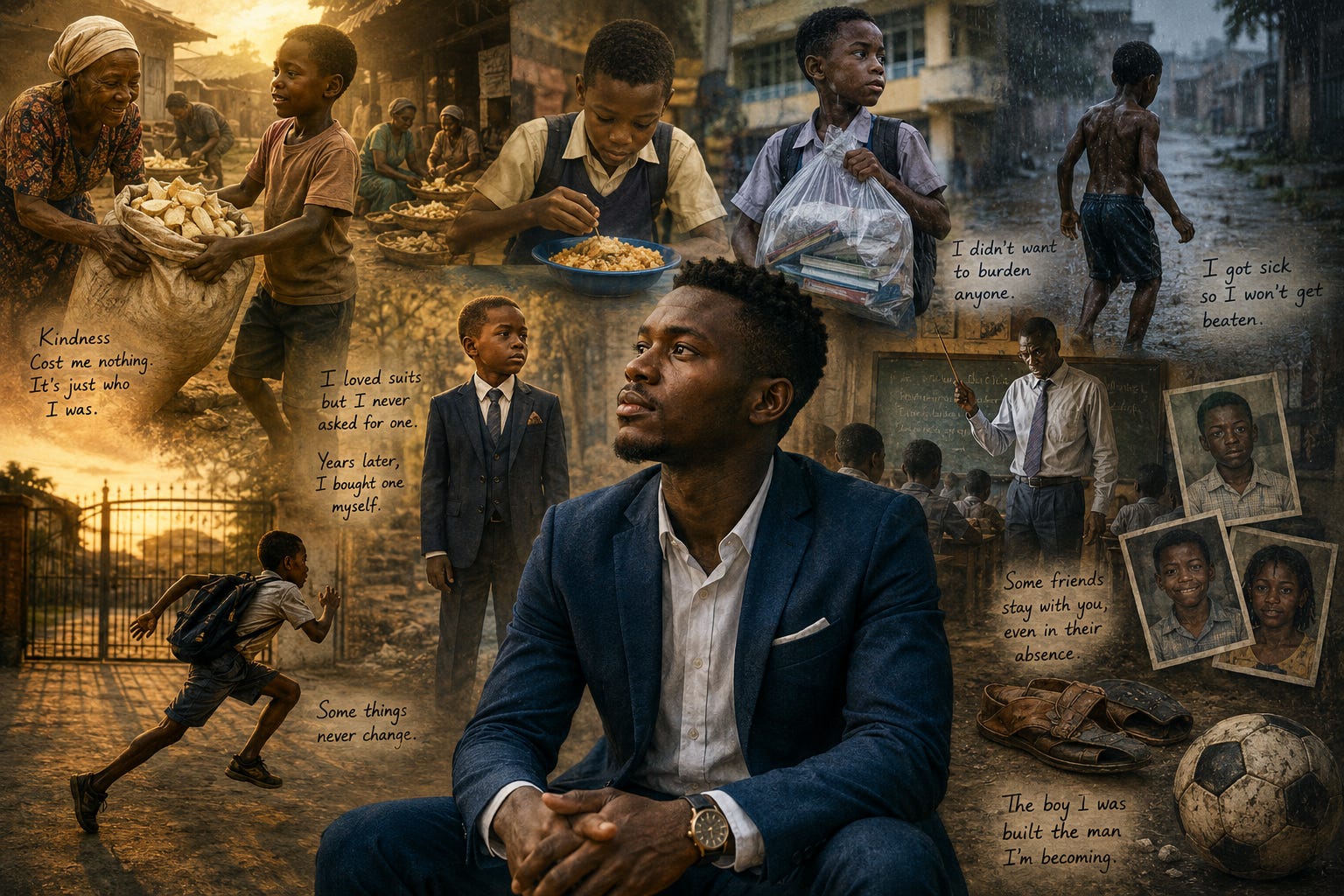
“Mama, can I help this elderly woman carry her bag of cassava peels?” I asked my grandmother.
I remember how proud she looked. She didn’t offer any word of praise, but her body did. She said yes.
I was a kid sitting among women displaying the understated art of peeling cassava. There was something it did to me. The synchronicity of their hands was a special sight. I loved to be in their midst. They spoke about tonnes of subjects. They knew everything.
The smooth, lush nature of the tuber paid homage to their skill. Sometimes, I’d try to copy them, and I’ll take a heavy cut of the cassava. My grandma will simply say “I said you can’t do it, don’t worry”.
I loved being there.
One day, an elderly woman came to pack the peels for her goats. She’d dry them until they turned crunchy before feeding them to her animals. Seeing the weight she had to carry, and her age, I felt pity for her. That’s what led me to ask my grandmother if I could help with the sack.
That was the kid I was. I loved being kind. I genuinely wanted to help people. I saw everyone as saintly.
There was a woman I tried to help many times but she never heeded. One day, I asked my grandma why she never allowed anyone carry her load. She didn’t say much. For that kid, maybe I wouldn’t have understood. The lesser I knew, the better.
But that wasn’t all. I was calm. I had character. I had an incredible level of independence, and I genuinely think I was sometimes smarter than I should have been. Being a smart kid may take the joys of childhood away sometimes. I think kids should be kids.
I matured early. I didn’t enjoy the things kids my age enjoyed. One of my friends once said I didn’t have a childhood.
He’d grown tired of my inability to relate to the memories normal children have.
“Did you watch this?”
No.
“Did you play that?”
No.
“What nursery rhyme do you know?”
Errrm. Maybe Twinkle, Twinkle, Little Star. I don’t even remember being taught.
I went to a fantastic primary school. I was just not much of a child when I was one. When we answered questions and everyone clapped, I was always shy to clap.
I questioned things in ways that didn’t always look like questioning. I was curious. My curiosity made me find so many things a child will not fully understand.
There were things I did differently too.
I was in Primary 4. We paid ₦100 every week for lunch in school. Two meals ran through the week: jollof rice, and beans with garri on alternate days. I still remember those blue plates. They were never enough for me.
One day, my father gave me the money for lunch. I kept it.
I watched my classmates eat while I went hungry because I didn’t think the food was worth the money. Instead, I spent it on fries from one of the women who attended to us on the school bus. To me, that was a better deal.
Some weeks I paid for lunch. Other weeks I did the same thing. I made decisions that probably looked strange for my age. Nobody told my dad. That’d have been an accident.
Another memory is from Primary 5.
It was our end-of-year Christmas party, and each pupil was to pay ₦500. I never mentioned it at home.
On the day of the party, I dressed in black jeans and a nice shirt. I left the house looking like I was headed to school, but after walking about 400 metres, far enough that nobody who cared would see me, I let myself into Samson’s house.
Samson lived on the same street. His parents weren’t around. Unlike me, he’d told them about the fee, but they couldn’t afford it, so he stayed home.
I spent the day there.
When the party ended and pupils started making their way home, I joined them.
My dad asked how the event went.
“Fine.”
Looking back now, I know I lied. But I also know why I did.
My final days in primary school were rough. I never complained. I understood the situation at home. I wasn’t a kid in the sense of my awareness.
For a whole term, I wore a school vest to class because my uniform had torn and that was what we could afford. I’d not say a thing at home.
When my school bag got cut, I carried my books in a sturdy plastic bag. It didn’t bother me much. I had only a term left before leaving primary school.
That’s not to say I had no pride.
One Monday morning, my sandal got cut and I didn’t tell anyone. All through the weekend, I was playing about. I didn’t say a thing but Monday morning came and I bickered so much.
My dad searched for a solution and asked me to wear a pair of rubber slippers to school.
I refused.
Think about that. A child in primary school insisting on his own way.
My father was livid. His eyes turned red and he hurled the sandal at me with incredible force.
One thing about me: I’m quick to spot flying objects. I dodged it.
Only then did I leave in the slippers. I felt inadequate in them.
When I got back, my cut sandal had been repaired and polished. My father even went the extra mile. My sandals never got polished.
Kids can be difficult. I certainly was on some days.
I remember a teacher asking why I carried my books in plastic bags instead of a school bag. To me, it wasn’t a problem. I was getting to school every morning, and that was enough.
I sometimes wonder if that’s why my brother spent a chunk of his modest salary buying me a proper school bag when I got to secondary school. Maybe he’d seen me all along.
We were in Elementary Science class when our teacher, a tall man who hardly smiled, asked a question nobody could answer. He threatened to beat us all the next morning.
I didn’t like that teacher.
He’d beaten me before. Once for opening my notes after he asked a question. Another time for missing two exams I somehow hadn’t realised I’d missed.
So when he threatened the whole class, I wasn’t interested in becoming his victim again. Especially when I’d been slapped on the face by a teacher who taught French for similar reasons. It’s the first and last time anyone did that to me.
Then it rained.
From my bus stop to our house, I walked through it without taking cover. I wanted to get soaked. I had a plan.
As soon as I got home, I stripped off my clothes. Luckily, NEPA hadn’t taken the light. If you’re Nigerian, you know that’s like gold. It’s a rare thing.
The standing fan in my father’s room was still working.
I turned it to full speed.
By evening, I had a fever. My father gave me medicine, felt my hot body, and excused me from school the next day. I banked on his compassion.
I’d gotten what I wanted.
The funny thing is, the teacher never beat anyone over that question.
But what was I thinking?
I just wanted to survive, and that was the shape survival took in that moment.
Childhood gave me funny memories too. Like the neighbour who convinced me that water closets were built on rivers and that human waste flowed straight into them. I believed him. I’d hardly used a water closet before. Funny as it sounds, I was a poor boy.
Or the time he came to me asking what ‘Sec school’ was because a girl told her on 2go that she’s in ‘Sec school’. The way he pronounced it was funny. I barely understood it.
There was another neighbour who apologised for farting. We’d gather in front of the house and you’ll hear this embarrassing sound from the other side. She’d simply say “sorry, mo só” with an Ijebu dialect.
As a kid, I loved suits.
I never told anyone. I simply admired the children who wore them. They looked out of reach, though they probably weren’t. I thought they were because the suits I saw in movies were worn by people going to offices.
My dad worked in Agriculture. The first day he wore a piece of suit to his office, I laughed so hard within that my belly ached.
I learned early not to ask for what I wanted if getting it meant costing someone else. I never asked for one. Eventually, it became a quiet wish.
Years later, I bought one myself.
A very good one.
Some wishes wait patiently.
Childhood also gave me memories I wish it hadn’t.
In JSS 1, my closest friend was Olamide.
Back in Primary 2, our classes clashed one morning. Boys were fighting for no sensible reason. I walked into Olamide’s class, carried him, and gently slammed him on the floor, and left for my class.
When they named culprits, of course they remembered ‘Riliwan’. I was named and we were punished.
That was my contribution.
Olamide is dead now.
The day I heard about his demise, I remembered something his sister said when we collected our first results in secondary school.
“Look at your friend.” I was one of the best 20 results in the whole ten arms of the class. But I barely cared. His sister was impressed.
She meant well. I remember feeling uncomfortable with the comparison even then.
Another mate I lost was Blessing, the boy who pronounced “teacher” as “chicha” every single time and called me “Ronaldinho” the day my dad came to school.
Then there was Oreoluwa, one of the brightest students I knew as a child.
They’re all gone.
I can’t think about them without feeling fortunate to still be here.
The man I am still carries the child I was.
I still pick up pebbles, throw them into the air and trap them like a football. I still try to control every falling object with my foot.
The other day, I sprinted to the gate of my apartment building before it shut. I probably broke the world record that day.
I’ve raced motorcycles and cars; races those vehicles never knew they were part of.
I’ve raced bicycles too. Those, I usually beat.
Whenever a football rolled out for me to fetch, I’d give myself a point it wasn’t allowed to cross before I caught it.
It made me quicker. More athletic.
The man I am is grateful to the child I was.
There were things I could have handled better, but maybe those moments are exactly why I’m still here, still chasing gates before they shut, still trapping pebbles with my foot like a ball.
No matter what I accomplish in life, I’ll always be grateful to that boy.
Originally published on Wolf of Words Street.