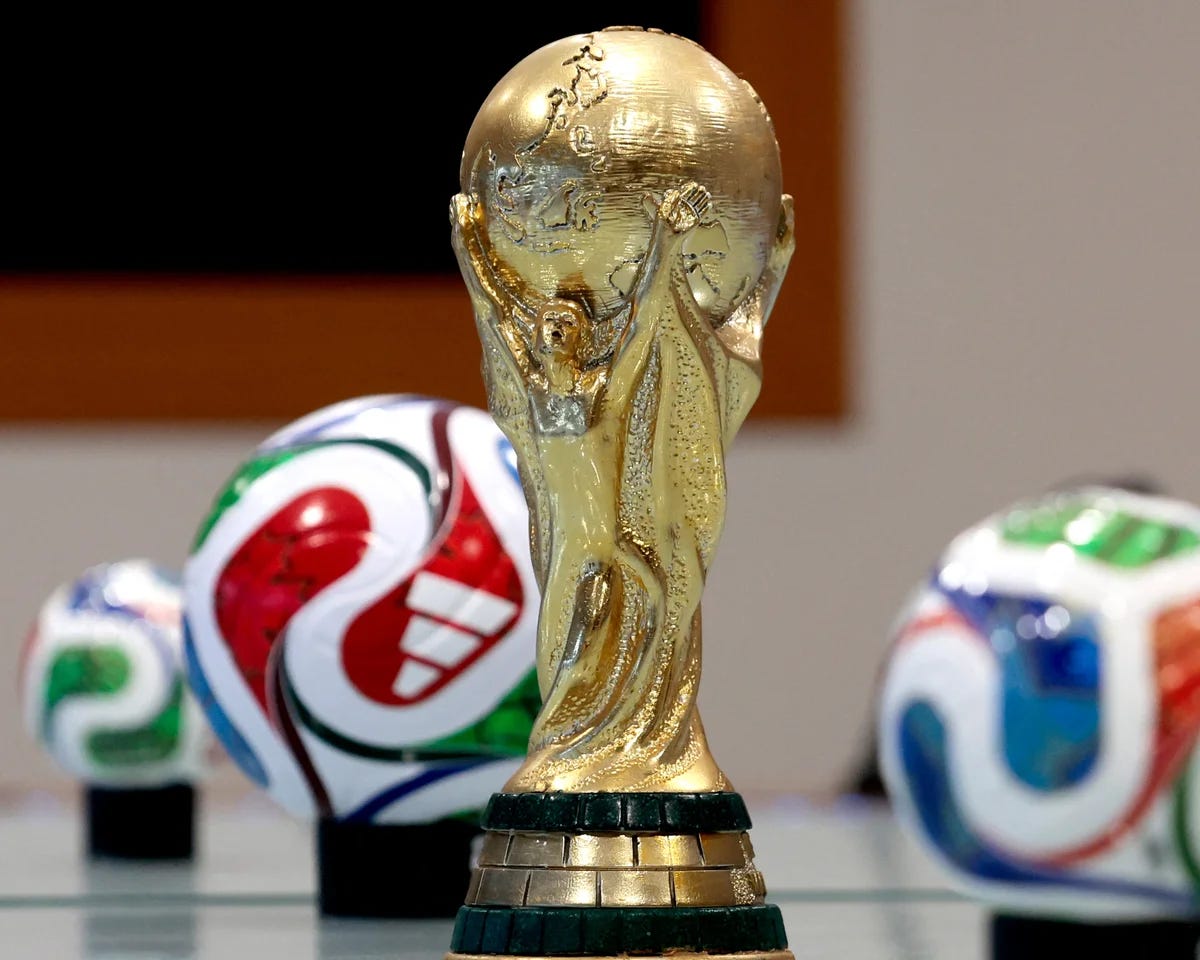
When you lose a crucial World Cup game, the best you can do is wait.
No matter how hurt you feel, or how determined you are to right your wrongs, you’ll have to wait.
That wait lasts four years.
Along the way, you may win league titles, continental trophies and individual awards, but there is still that one prize you couldn’t win. It isn’t available every season. It isn’t even available every other year.
That’s how FIFA has turned the World Cup into one of the greatest products in sport.
Scarcity creates value. FIFA understands that better than almost any sporting organisation.
Stage that scarce product in the world’s largest consumer economy and one of its most commercially sophisticated markets, and FIFA suddenly has an extraordinary business opportunity.
The World Cup is scarce. Other than coming every four years, it isn’t an experience most people get to have. Football fans can buy tickets to league matches or the UEFA Champions League, but getting World Cup tickets is significantly harder.
It isn’t a tournament that comes around every weekend. It doesn’t happen every year. It isn’t biennial.
That is precisely what makes it special.
For football fans, attending the World Cup is almost an article of ostentation. It is a rare experience that is treated with enormous reverence because supporters know it won’t always come around. They don’t want to miss it because life happens. Circumstances change. Four years is a long time in anyone’s life.
Perhaps that’s why the World Cup has become more than a football tournament.
It has become a way of measuring human progression.
Where were you at the last World Cup?
Where are you now?
FIFA has built a product worth around $10 billion, and the United States has amplified its commercial potential.
Hosting the tournament in the world’s biggest commercial market has exposed football to sponsors, broadcasters and audiences on an unprecedented scale. The United States may not have fully appreciated football’s global pull for decades, but it certainly understands it now. An American-themed World Cup has arrived at a time when globalisation is reshaping entertainment, commerce and culture.
FIFA has also given America a measure of creative influence over the competition. Some traditionalists dislike that shift, but commercially it has been difficult to ignore.
Brands don’t want to miss out. The World Cup places billions of eyes on one event at the same time. Commercial interest has continued to grow since Qatar 2022, and future tournaments are likely to attract even more sponsors and partners. Previously uninterested brands now have compelling reasons to invest in football.
The sport has always been a global religion. And it is increasingly becoming a viable commercial asset.
America is only now fully experiencing its reach.
Between 2023 and 2026, FIFA forecast billions of dollars in broadcasting revenue alone. Football’s commercial side has become impossible to ignore, despite objections from some of the game’s purists.
Scarcity is doing what constant availability may never have achieved.
People want what they cannot easily have, and football fans before now, had so much football. For free.
FIFA is now building an empire around one of the oldest truths about human behaviour. People respect rarity.
The World Cup has become a premium product because access is limited, demand is overwhelming and the experience cannot be replicated elsewhere.
Yet scarcity has its limits.
The more valuable the tournament becomes, the louder the debate over who gets access to it.
Many supporters argue that football’s biggest competition has gradually become less accessible to ordinary fans. Even after expanding to 48 teams, many still feel priced out of the experience.
That debate explains why FIFA and UEFA have occasionally found themselves pulling in different directions.
In several European countries, major football tournaments remain protected on free-to-air television. Broadcasters purchase the rights from FIFA before making the matches available to the public, ensuring that the sport remains widely accessible rather than becoming an entirely premium product.
That balance between commercial ambition and public access may ultimately define FIFA’s future.
The organisation understandably wants to maximise the value of its greatest asset, but the World Cup became football’s greatest spectacle because it belonged to everyone.
America has shown FIFA what football can become when scarcity meets the world’s biggest commercial stage. FIFA has forecasted revenues of $10bn in the ongoing World Cup, double of what they recorded four years ago.
The harder challenge begins now.
The World Cup will leave the United States, but FIFA cannot allow the attention to leave with it. An American World Cup is box office.
Keeping that interest alive until the next tournament arrives four years later will be even harder.
Originally published on Wolf of Words Street.