In another month, Mikel Arteta will have spent seven years as Arsenal’s manager. In that period, he has grown into one of the finest managers in the world, in every sense of the word.
When the young Arteta walked through the doors at Arsenal again, it was a return that came with enormous demands and expectations. The club he had retired from as captain was in the doldrums, far removed from the standards that had once made it an elite institution, and seemingly stripped of its joy and sense of belonging.
The mood was insipid. He had a massive amount of work on his hands. During his first tour as manager, he walked into the room where his friend and former Arsenal deputy captain, Per Mertesacker, was sitting and told him: “Mertesacker, you know we have big work to do.”
Arteta understood where Arsenal stood as a club and had a clear picture of where it needed to be. For nearly four years, he had served as number two in one of the most demanding environments in modern football, working under a manager whose obsession with excellence has sometimes been described as self-destructive.
There was a gulf between where Arsenal were and where they needed to be. The club’s hierarchy was not oblivious to the fact that rebuilding would require sacrifice, patience and a willingness to endure difficult periods before enjoying the rewards. It was what the times demanded.
“I will give every drop of blood for this football club to make it better,” Arteta said in his first press conference.
His choice of words belonged to a man deeply in love with his new job, but also one who could see what Arsenal could become if everything fell into place.
“I know the expectations, I know the level, I know the stature of this club and what it deserves. I’m ready for that challenge.”
Compare his words with those of other managers embarking on their first managerial appointments, and the difference in perspective becomes apparent. Arteta saw a job, certainly, but perhaps more importantly, he felt an obligation to give everything he had to the institution. He wasn’t simply taking charge of a football team; he was accepting responsibility for restoring a club’s identity and reputation.
His personal circumstances reflected the scale of that commitment. His wife, who was pursuing an acting career, had relocated to Los Angeles with their three sons while Arteta was assistant manager at Manchester City. When the Arsenal opportunity arrived, his family returned to London because he needed them around him to function at his best. Everything that could be done to give the project the best possible conditions was done.
From the beginning, Arteta made it clear that culture would be central to his management. He wanted to build something that transcended every individual at the club.
“I don’t want people hiding. I want people taking responsibility for the job,” he said.
“The players have to accept a different process, a different way of thinking.”
If those statements were clear instructions about what was to come, his warning to anyone unwilling to embrace the culture was even more revealing.
“Anybody that doesn’t buy into this is not good enough for this environment or culture.”
It was a level of directness that many young managers might have avoided. Arteta, however, was already establishing the terms on which he intended to operate. There would be no room for passengers, excuses or individuals who considered themselves bigger than the collective.
Yet, for all his discipline, Arteta has always been a manager whose warmth is as apparent as his demands. He has spoken about wanting to understand how his players feel and what they need, while also acknowledging one of the most important lessons he has learnt in management: ruthlessness.
Look across the years and examine how Arsenal have been run under him. Arteta has never been afraid of making difficult decisions, and he has enjoyed the full backing of the club. He stripped high earners and influential players of their places in the team, removed a club captain, dropped a goalkeeper who was a fan favourite and stood firmly behind his decisions. In taking Arsenal to the next level, he has made enemies along the way, but winning the approval of a few individuals was never going to be more important than restoring the collective pride of the Arsenal support.
2019–2021: The language of responsibility and reconstruction
Arteta’s earliest communication was shaped by the size of the task before him. He had inherited a club that needed more than tactical adjustments. Arsenal needed a cultural reset, a renewed sense of purpose and a manager capable of making people believe that better days were possible.
His language reflected that responsibility. He spoke about sacrifice, standards, accountability and belonging. He wanted people to understand that they were part of something bigger than themselves.
There was also an unmistakable sense of urgency. Arteta was not going to spend his early months asking people to believe in him without demanding something in return. He wanted commitment, and he wanted it immediately.
Year on year, Arsenal progressed under him. There were periods when it felt as though he might not see the following day as manager, but the club continued to back him, even through a difficult run. Two consecutive eighth-place finishes, followed by a fifth-place finish and a painful Champions League miss, were also periods when his quality and suitability for the job were questioned by sections of the fanbase.
2021–2023: The language of authority and accountability
Through those difficult phases, one thing remained consistent: Arteta’s style of communication. He is a heavy talker. He chooses his words carefully, understands the context in which he is speaking and rarely throws them around without purpose.
There have been moments when he has displayed anger and described officiating as a disgrace. There have also been occasions when he has spoken about understanding English culture and the way people react to things they consider their own. Across these periods, there has been a significant level of control in his speech and public utterances. He understands the weight of words.
It is difficult to catch Arteta off guard. From all indications, he prepares meticulously for his press conferences and appears to enjoy sitting with journalists to have a conversation. In some respects, the press room seems to be a classroom for him too, an opportunity to refine his leadership communication and methods.
As Arsenal moved closer to becoming genuine title contenders, his communication began to reflect a manager who had established authority within the club. The language of reconstruction gradually gave way to the language of accountability. He no longer needed to spend every conversation explaining why change was necessary. He could demand that the players deliver on the standards he had spent years establishing.
2023–2025: The language of conviction and reassurance
As Arsenal chased the Premier League title, hoping to end their long wait for another championship, Arteta’s choice of language took another turn. He sounded increasingly reassuring.
In the 2023/24 season when Arsenal broke many records, Arteta declared that his team would have been champions in many Premier League seasons. It was a bitter loss but in the final game of the season, he reiterated his desire to go again.
The following season brought challenges they’d never have imagined as Arsenal struggled with injuries. Despite losing only four times, they drew 12 games and Liverpool won the title. His communication that season felt like a man who accepted that it was circumstantial.
In that summer’s transfer window, the unannounced name of the approach was perhaps “Operation Never Again” as Arsenal built depth and quality in preparation for the haul.
One of the things that stands Arteta out is his confidence. He believes in the preparation of his team, understands the demands of the occasion and takes responsibility for what happens. He has always been willing to put himself at the centre of the conversation, particularly when things go wrong.
But there was something else emerging: a greater awareness of the psychological demands of competing for the biggest prizes.
It is easy to become so consumed by ambition that the destination takes precedence over the journey. Arteta understood the pressure building around his players and increasingly sought to bring their attention back to the immediate task.
He wanted them to live in the present, rather than become overwhelmed by what winning the title would mean.
“We have a very clear instruction for ourselves, we have to live in the present,” he said at the press conference before Arsenal’s trip to Tottenham.
“What we did in the past is great but we have to be in the present and it is beautiful. We are exactly where we want to be in every competition but there is still lots to play, and we need to earn it like we have done in the last seven or eight months.”
It was an important message at a delicate point in the season. Arsenal were staring another potential disappointment in the face, and Arteta needed his players to concentrate on what they could still influence. They went on to defeat Tottenham 4-1, earning back some trust and belief.
One phrase from that press conference deserves particular attention: earning the right to win.
Arteta uses this expression constantly, particularly when addressing players who are less involved. His belief that nothing should be handed to anyone on a platter of gold runs through his interactions. He understands the value of work and wants his players to understand that privilege in football comes with responsibility.
After their disappointing defeat to Manchester City in the league, despite creating enough opportunities to win, Arteta said Arsenal were now convinced that the wait was over. Declan Rice, however, appeared to have fueled that view. He shook his head, breathing heavily after a demanding game, his face reddened, and uttered the words: “It’s not done.”
It felt like a shot of adrenaline.
The moment spread across social media like wildfire. For Arsenal supporters, it was a reminder that the players understood the enormity of what remained and were not prepared to give up without a fight.
It came right after Arteta had declared, “I’m on fire”, following the Bournemouth defeat.
The loss at the Emirates was particularly painful. Arteta admitted that he had doubted his ability to lift the team and take it further. It was a rare glimpse into the uncertainty that can accompany the responsibility of managing a club with Arsenal’s ambitions. Thankfully, the players found a way to lift themselves, responding to the disappointment with renewed determination.
They literally lit a fire at the training ground to kill negative energy, away from Arteta’s usual unorthodox methods of motivation.
Arteta later acknowledged that he, too, had questioned his capacity to go further after what seemed for a moment like yet another close call.
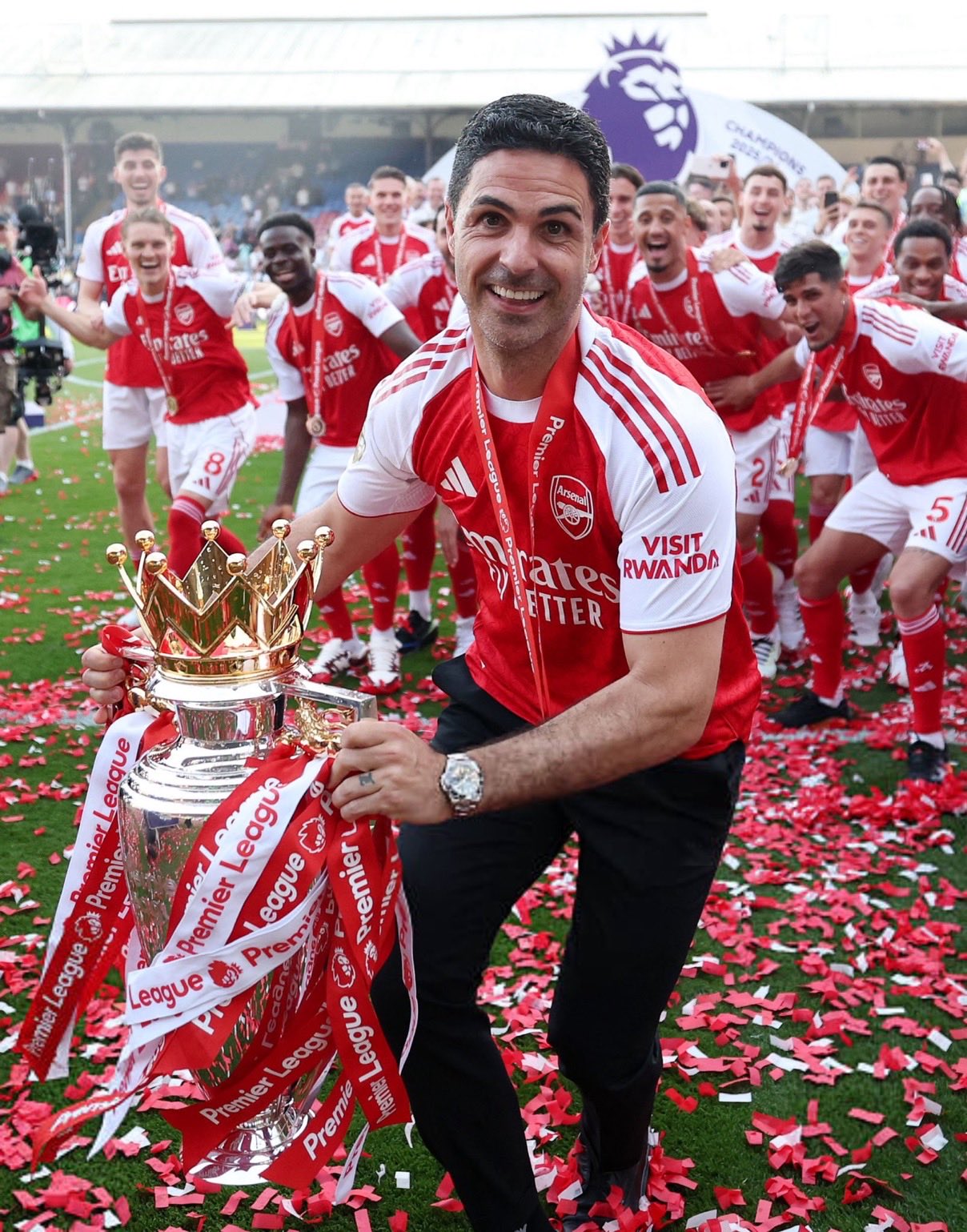
The team eventually achieved its objective, and the celebrations reflected the hunger of a group that had endured years of frustration.
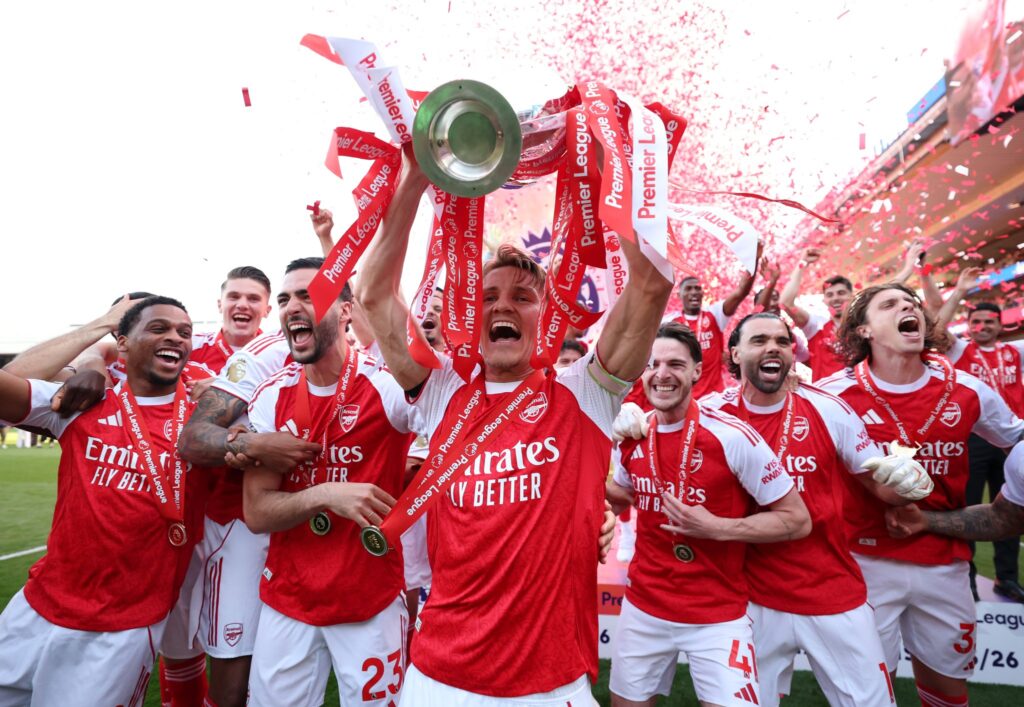
2025–2026: The language of confidence and sustained ambition
What has followed has been an even clearer and more confident communication style from the Arsenal manager.
One of his most striking statements came when he insisted that Arsenal would not defend their title but attack it. It was a deliberate choice of language. Rather than wait to be hunted by the chasing pack, he wanted his team to remain proactive and take the initiative.
When asked about the target on their backs, Arteta was quick to dismiss the idea that previous achievements would offer them any protection. They were in a new season, on a fresh page, and would have to prove themselves all over again.
Very early in the campaign, he also established the standards expected of the team. Whoever thought winning once was enough, he suggested, would have to find somewhere else to work.
“I think the message was clear from day one,” he said. “If you think differently, I don’t think you have to be here. You have to be somewhere else.”
It was a clear indication of the scale of his ambition. Peter Kenyon, the former chief executive at Manchester United and Chelsea, has spoken about how elite managers are never satisfied. Once they achieve something, they want to do it again. That mentality is increasingly evident in Arteta’s communication.
Where standards have dropped, he has been quick to remind his players of what is required. After the disappointing defeat to Brighton and the cup elimination against Fleetwood Town, he made no attempt to disguise his dissatisfaction.
“There are certain basics that you need to accomplish in the Premier League that we were very far from,” he said.
“The amount of technical errors we did… we didn’t respect any principle of play.”
That was a manager telling his players they had fallen well below the required level. He acknowledged the opposition’s superiority on the day without deflecting responsibility or searching for excuses.
In the game against Fleetwood Town, where he was criticised for publicly admonishing Max Dowman following a red card for retaliation, Arteta defended his approach. He reiterated that the youngster would have to earn his right to play and should expect to be targeted because of the player he is and the attention he attracts.
Importantly, he reminded everyone that professional football is not Disneyland. It is a competitive environment, and nobody is entitled to an easy ride.
For all his straight-cut approach, however, Arteta is not a leader without humour or warmth. He has a playful side. There are numerous clips of him jumping on the backs of his players during training sessions, sharing jokes and enjoying their company.
At the press conference before Arsenal’s game against Hull City, he congratulated a journalist on having a daughter and joked that the journalist was better than him because he had tried to have a girl but failed.
These moments are important because they reveal another side of his leadership. Discipline and warmth are not mutually exclusive. Arteta can demand the highest standards while maintaining a personal connection with the people responsible for delivering them.
He can speak about Bukayo Saka being out for two months without appearing visibly unsettled. He is in a much calmer position than he was when he first arrived, yet the demand for silverware is even greater. Arsenal now travel to every ground expecting to compete for victory. When they went to Anfield some weeks ago, Arteta’s message was simple: “It’s time to do it.”
His communication has also earned him recognition beyond football. His appointment as a director at sportswear brand Under Armour reflects the wider interest in his leadership methods and the principles he has brought to Arsenal.
There is, perhaps, a correlation between Arteta’s growing authority as a manager and the changing texture of his language. In the early days, his words carried the urgency of a man trying to convince an institution to believe in a project that had yet to yield tangible rewards. He needed to establish standards, demand patience and make people understand the scale of the reconstruction.
Today, he speaks from a position of greater authority. He has earned the right to demand more, and his language reflects a manager who no longer needs to explain why Arsenal should aspire to greatness. He expects them to live up to it.
The burden has not disappeared. If anything, the expectations have become greater. But Arteta has grown more comfortable carrying it.
From that first day at London Colney, when the size of the task before him was centred on restoring the club’s reputation and standing, he has become a manager whose words increasingly carry the conviction of someone who expects to win.
He arrived promising to give every drop of blood for Arsenal. Today, he speaks like a man who believes the club must continue to demand everything from itself.
It is a remarkable evolution. And perhaps that is what happens when a manager grows into the institution he has been entrusted to rebuild.